> ## Documentation Index
> Fetch the complete documentation index at: https://leetcode-py.wisl.dev/llms.txt
> Use this file to discover all available pages before exploring further.
> ## Agent Instructions
> leetcode-py is a Python LeetCode practice environment generator with one CLI: lcpy. It is not a service or platform.
> Each problem is a directory under leetcode/ with README.md, solution.py, test_solution.py, helpers.py, and playground.ipynb. lcpy gen creates them from JSON templates bundled with the package.
> Examples are backed by tests; copy them verbatim.
# Check if Grid can be Cut into Sections
> Tested Python solution for LeetCode 3394 with 18 pytest cases. Generate a practice environment with lcpy.
LeetCode 3394, [Medium](/catalog/medium). Topics: [Array](/catalog/topics/array), [Sorting](/catalog/topics/sorting). [View on LeetCode](https://leetcode.com/problems/check-if-grid-can-be-cut-into-sections/description/).
Generate this problem as a practice environment: tested reference solution, 18 [parametrized pytest cases](/practice/testing), and a playground notebook:
```bash theme={"theme":{"light":"github-light","dark":"github-dark"}}
lcpy gen -n 3394 # by problem number
lcpy gen -s check_if_grid_can_be_cut_into_sections # by problem name
```
## Problem
You are given an integer \n\ representing the dimensions of an \n x n\ grid, with the origin at the bottom-left corner of the grid. You are also given a 2D array of coordinates \rectangles\, where \rectangles\[i]\ is in the form \\[start\x\, start\y\, end\x\, end\y\]\, representing a rectangle on the grid. Each rectangle is defined as follows:
* \(start\x\, start\y\)\: The bottom-left corner of the rectangle.
* \(end\x\, end\y\)\: The top-right corner of the rectangle.
\Note \that the rectangles do not overlap. Your task is to determine if it is possible to make \either two horizontal or two vertical cuts\ on the grid such that:
* Each of the three resulting sections formed by the cuts contains \at least\ one rectangle.
* Every rectangle belongs to \exactly\ one section.
Return \true\ if such cuts can be made; otherwise, return \false\.
### Examples
```
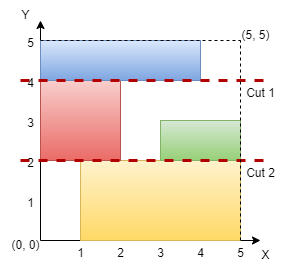
Input: n = 5, rectangles = [[1,0,5,2],[0,2,2,4],[3,2,5,3],[0,4,4,5]]
Output: true
```
**Explanation:** The grid is shown in the diagram. We can make horizontal cuts at \y = 2\ and \y = 4\. Hence, the output is true.
```
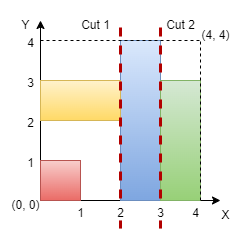
Input: n = 4, rectangles = [[0,0,1,1],[2,0,3,4],[0,2,2,3],[3,0,4,3]]
Output: true
```
**Explanation:** We can make vertical cuts at \x = 2\ and \x = 3\. Hence, the output is true.
```
Input: n = 4, rectangles = [[0,2,2,4],[1,0,3,2],[2,2,3,4],[3,0,4,2],[3,2,4,4]]
Output: false
```
**Explanation:** We cannot make two horizontal or two vertical cuts that satisfy the conditions. Hence, the output is false.
### Constraints
* 3 \<= n \<= 10^9
* 3 \<= rectangles.length \<= 10^5
* 0 \<= rectangles\[i]\[0] \< rectangles\[i]\[2] \<= n
* 0 \<= rectangles\[i]\[1] \< rectangles\[i]\[3] \<= n
* No two rectangles overlap.
## Solution
Reference implementation from [solution.py on GitHub](https://github.com/wislertt/leetcode-py/blob/main/leetcode/check_if_grid_can_be_cut_into_sections/solution.py), full suite in [test\_solution.py](https://github.com/wislertt/leetcode-py/blob/main/leetcode/check_if_grid_can_be_cut_into_sections/test_solution.py):
```python theme={"theme":{"light":"github-light","dark":"github-dark"}}
class Solution:
# Time: O(m log m)
# Space: O(m)
def check_valid_cuts(self, n: int, rectangles: list[list[int]]) -> bool:
return self._has_two_gaps(rectangles, 0) or self._has_two_gaps(rectangles, 1)
def _has_two_gaps(self, rectangles: list[list[int]], axis: int) -> bool:
rects = sorted(rectangles, key=lambda rect: (rect[axis], rect[axis + 2]))
gaps = 0
end = rects[0][axis + 2]
for rect in rects:
if rect[axis] >= end:
gaps += 1
if gaps >= 2:
return True
end = max(end, rect[axis + 2])
return False
```
## Complexity
| Time | Space |
| - | - |
| O(m log m) | O(m) |
## Tags
[NeetCode All](/catalog/neetcode).
This documentation is built and hosted on [Mintlify](https://mintlify.com), a developer documentation platform.