> ## Documentation Index
> Fetch the complete documentation index at: https://leetcode-py.wisl.dev/llms.txt
> Use this file to discover all available pages before exploring further.
> ## Agent Instructions
> leetcode-py is a Python LeetCode practice environment generator with one CLI: lcpy. It is not a service or platform.
> Each problem is a directory under leetcode/ with README.md, solution.py, test_solution.py, helpers.py, and playground.ipynb. lcpy gen creates them from JSON templates bundled with the package.
> Examples are backed by tests; copy them verbatim.
# Filling Bookcase Shelves Python Solution
> Tested Python solution for LeetCode 1105 with 12 pytest cases. Generate a practice environment with lcpy.
LeetCode 1105, [Medium](/catalog/medium). Topics: [Array](/catalog/topics/array), [Dynamic Programming](/catalog/topics/dynamic-programming). [View on LeetCode](https://leetcode.com/problems/filling-bookcase-shelves/description/).
Generate this problem as a practice environment: tested reference solution, 12 [parametrized pytest cases](/practice/testing), and a playground notebook:
```bash theme={"theme":{"light":"github-light","dark":"github-dark"}}
lcpy gen -n 1105 # by problem number
lcpy gen -s filling_bookcase_shelves # by problem name
```
## Problem
You are given an array \books\ where \books\[i] = \[thickness\i\, height\i\]\ indicates the thickness and height of the \i\th\\ book. You are also given an integer \shelfWidth\.
We want to place these books in order onto bookcase shelves that have a total width \shelfWidth\.
We choose some of the books to place on this shelf such that the sum of their thickness is less than or equal to \shelfWidth\, then build another level of the shelf of the bookcase so that the total height of the bookcase has increased by the maximum height of the books we just put down. We repeat this process until there are no more books to place.
Note that at each step of the above process, the order of the books we place is the same order as the given sequence of books.
For example, if we have an ordered list of \5\ books, we might place the first and second book onto the first shelf, the third book on the second shelf, and the fourth and fifth book on the last shelf.
Return \the minimum possible height that the total bookshelf can be after placing shelves in this manner\.
### Examples
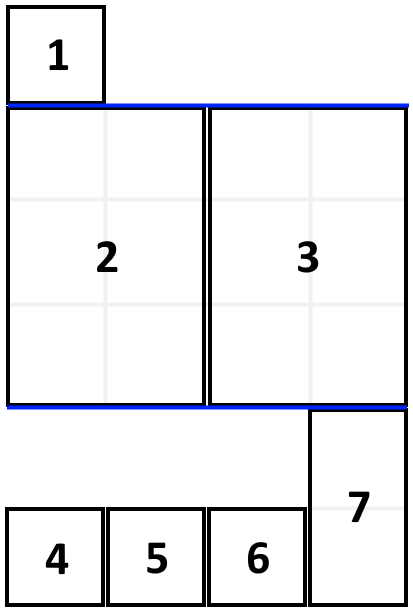
```
Input: books = [[1,1],[2,3],[2,3],[1,1],[1,1],[1,1],[1,2]], shelfWidth = 4
Output: 6
Explanation: The sum of the heights of the 3 shelves is 1 + 3 + 2 = 6. Notice that book number 2 does not have to be on the first shelf.
```
```
Input: books = [[1,3],[2,4],[3,2]], shelfWidth = 6
Output: 4
```
### Constraints
* \1 \<= books.length \<= 1000\
* \1 \<= thickness\i\ \<= shelfWidth \<= 1000\
* \1 \<= height\i\ \<= 1000\
## Solution
Reference implementation from [solution.py on GitHub](https://github.com/wislertt/leetcode-py/blob/main/leetcode/filling_bookcase_shelves/solution.py), full suite in [test\_solution.py](https://github.com/wislertt/leetcode-py/blob/main/leetcode/filling_bookcase_shelves/test_solution.py):
```python theme={"theme":{"light":"github-light","dark":"github-dark"}}
class Solution:
# Time: O(n * W)
# Space: O(n)
def min_height_shelves(self, books: list[list[int]], shelf_width: int) -> int:
n = len(books)
dp = [0] + [10**9] * n
for i in range(1, n + 1):
total_w = 0
max_h = 0
for j in range(i, 0, -1):
total_w += books[j - 1][0]
if total_w > shelf_width:
break
max_h = max(max_h, books[j - 1][1])
dp[i] = min(dp[i], max_h + dp[j - 1])
return dp[n]
```
## Complexity
| Time | Space |
| - | - |
| O(n \* W) | O(n) |
## Tags
[NeetCode All](/catalog/neetcode).
This documentation is built and hosted on [Mintlify](https://mintlify.com), a developer documentation platform.