> ## Documentation Index
> Fetch the complete documentation index at: https://leetcode-py.wisl.dev/llms.txt
> Use this file to discover all available pages before exploring further.
> ## Agent Instructions
> leetcode-py is a Python LeetCode practice environment generator with one CLI: lcpy. It is not a service or platform.
> Each problem is a directory under leetcode/ with README.md, solution.py, test_solution.py, helpers.py, and playground.ipynb. lcpy gen creates them from JSON templates bundled with the package.
> Examples are backed by tests; copy them verbatim.
# Flip Equivalent Binary Trees Python Solution
> Tested Python solution for LeetCode 951 with 13 pytest cases. Generate a practice environment with lcpy.
LeetCode 951, [Medium](/catalog/medium). Topics: [Tree](/catalog/topics/tree), [Depth-First Search](/catalog/topics/depth-first-search), [Binary Tree](/catalog/topics/binary-tree). [View on LeetCode](https://leetcode.com/problems/flip-equivalent-binary-trees/description/).
Generate this problem as a practice environment: tested reference solution, 13 [parametrized pytest cases](/practice/testing), and a playground notebook:
```bash theme={"theme":{"light":"github-light","dark":"github-dark"}}
lcpy gen -n 951 # by problem number
lcpy gen -s flip_equivalent_binary_trees # by problem name
```
## Problem
\For a binary tree \T\, we can define a \flip operation\ as follows: choose any node, and swap the left and right child subtrees.\
\A binary tree \X\ is \flip equivalent\ to a binary tree \Y\ if and only if we can make \X\ equal to \Y\ after some number of flip operations.\
\Given the roots of two binary trees \root1\ and \root2\, return \true\ if the two trees are flip equivalent or \false\ otherwise.\
### Examples
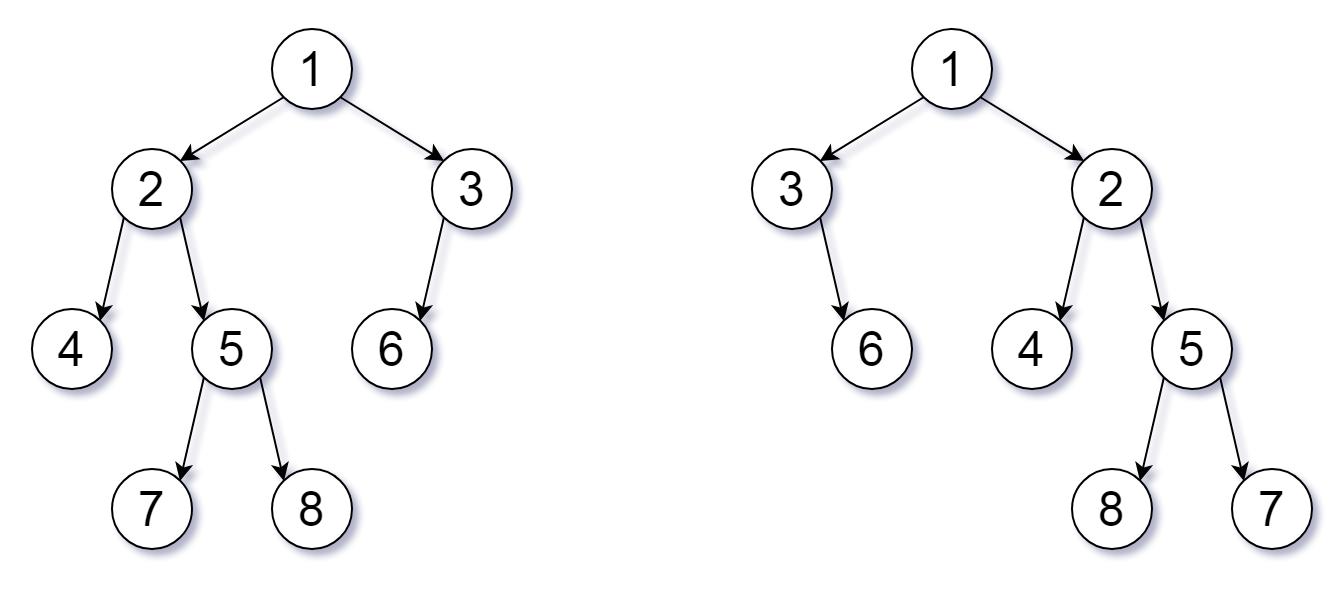
```
Input: root1 = [1,2,3,4,5,6,null,null,null,7,8], root2 = [1,3,2,null,6,4,5,null,null,null,null,8,7]
Output: true
Explanation: We flipped at nodes with values 1, 3, and 5.
```
```
Input: root1 = [], root2 = []
Output: true
```
```
Input: root1 = [], root2 = [1]
Output: false
```
### Constraints
\
\- The number of nodes in each tree is in the range \
\[0, 100]\.\
\- Each tree will have \unique node values\ in the range \
\[0, 99]\.\
\
## Solution
Reference implementation from [solution.py on GitHub](https://github.com/wislertt/leetcode-py/blob/main/leetcode/flip_equivalent_binary_trees/solution.py), full suite in [test\_solution.py](https://github.com/wislertt/leetcode-py/blob/main/leetcode/flip_equivalent_binary_trees/test_solution.py):
```python theme={"theme":{"light":"github-light","dark":"github-dark"}}
from leetcode_py import TreeNode
class Solution:
# Time: O(n)
# Space: O(h) where h is the tree height
def flip_equiv(self, root1: TreeNode[int] | None, root2: TreeNode[int] | None) -> bool:
if root1 is None or root2 is None:
return root1 is root2
if root1.val != root2.val:
return False
no_flip = self.flip_equiv(root1.left, root2.left) and self.flip_equiv(
root1.right, root2.right
)
flip = self.flip_equiv(root1.left, root2.right) and self.flip_equiv(root1.right, root2.left)
return no_flip or flip
```
## Complexity
| Time | Space |
| - | - |
| O(n) | O(h) where h is the tree height |
## Tags
[NeetCode All](/catalog/neetcode).
This documentation is built and hosted on [Mintlify](https://mintlify.com), a developer documentation platform.