> ## Documentation Index
> Fetch the complete documentation index at: https://leetcode-py.wisl.dev/llms.txt
> Use this file to discover all available pages before exploring further.
> ## Agent Instructions
> leetcode-py is a Python LeetCode practice environment generator with one CLI: lcpy. It is not a service or platform.
> Each problem is a directory under leetcode/ with README.md, solution.py, test_solution.py, helpers.py, and playground.ipynb. lcpy gen creates them from JSON templates bundled with the package.
> Examples are backed by tests; copy them verbatim.
# Largest Color Value in a Directed Graph
> Tested Python solution for LeetCode 1857 with 27 pytest cases. Generate a practice environment with lcpy.
LeetCode 1857, [Hard](/catalog/hard). Topics: [Hash Table](/catalog/topics/hash-table), [String](/catalog/topics/string), [Dynamic Programming](/catalog/topics/dynamic-programming), [Graph Theory](/catalog/topics/graph-theory), [Topological Sort](/catalog/topics/topological-sort), [Memoization](/catalog/topics/memoization), [Counting](/catalog/topics/counting), Directed Acyclic Graph. [View on LeetCode](https://leetcode.com/problems/largest-color-value-in-a-directed-graph/description/).
Generate this problem as a practice environment: tested reference solution, 27 [parametrized pytest cases](/practice/testing), and a playground notebook:
```bash theme={"theme":{"light":"github-light","dark":"github-dark"}}
lcpy gen -n 1857 # by problem number
lcpy gen -s largest_color_value_in_a_directed_graph # by problem name
```
## Problem
There is a \directed graph\ of \n\ colored nodes and \m\ edges. The nodes are numbered from \0\ to \n - 1\.
You are given a string \colors\ where \colors\[i]\ is a lowercase English letter representing the \color\ of the \i\th\\ node in this graph (\0-indexed\). You are also given a 2D array \edges\ where \edges\[j] = \[a\j\, b\j\]\ indicates that there is a \directed edge\ from node \a\j\\ to node \b\j\\.
A valid \path\ in the graph is a sequence of nodes \x\1\ -> x\2\ -> x\3\ -> ... -> x\k\\ such that there is a directed edge from \x\i\\ to \x\i+1\\ for every \1 \<= i \< k\. The \color value\ of the path is the number of nodes that are colored the \most frequently\ occurring color along that path.
Return \the \largest color value\ of any valid path in the given graph, or \\-1\\ if the graph contains a cycle\.
### Examples
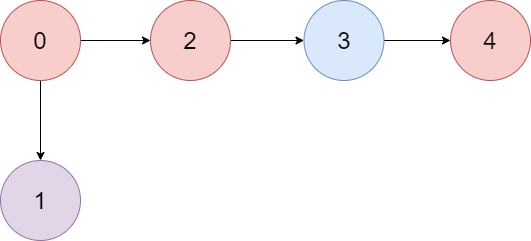
```
Input: colors = "abaca", edges = [[0,1],[0,2],[2,3],[3,4]]
Output: 3
```
**Explanation:** The path 0 -> 2 -> 3 -> 4 contains 3 nodes that are colored `"a" (red in the above image)`.
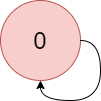
```
Input: colors = "a", edges = [[0,0]]
Output: -1
```
**Explanation:** There is a cycle from 0 to 0.
### Constraints
* `n == colors.length`
* `m == edges.length`
* `1 <= n <= 10^5`
* `0 <= m <= 10^5`
* `colors` consists of lowercase English letters.
* `0 <= aj, bj < n`
## Solution
Reference implementation from [solution.py on GitHub](https://github.com/wislertt/leetcode-py/blob/main/leetcode/largest_color_value_in_a_directed_graph/solution.py), full suite in [test\_solution.py](https://github.com/wislertt/leetcode-py/blob/main/leetcode/largest_color_value_in_a_directed_graph/test_solution.py):
```python theme={"theme":{"light":"github-light","dark":"github-dark"}}
class Solution:
# Time: O(n + m) with a constant factor of 26 colors
# Space: O(n)
def largest_path_value(self, colors: str, edges: list[list[int]]) -> int:
n = len(colors)
adj: list[list[int]] = [[] for _ in range(n)]
indegree = [0] * n
for src, dst in edges:
adj[src].append(dst)
indegree[dst] += 1
counts = [[0] * 26 for _ in range(n)]
for node in range(n):
counts[node][ord(colors[node]) - 97] = 1
queue = [node for node in range(n) if indegree[node] == 0]
processed = 0
best = 0
while queue:
node = queue.pop()
processed += 1
node_counts = counts[node]
local_best = max(node_counts)
if local_best > best:
best = local_best
for nxt in adj[node]:
nxt_counts = counts[nxt]
nxt_color = ord(colors[nxt]) - 97
for c in range(26):
cand = node_counts[c] + (1 if c == nxt_color else 0)
if cand > nxt_counts[c]:
nxt_counts[c] = cand
indegree[nxt] -= 1
if indegree[nxt] == 0:
queue.append(nxt)
return best if processed == n else -1
```
## Complexity
| Time | Space |
| - | - |
| O(n + m) with a constant factor of 26 colors | O(n) |
## Tags
[NeetCode All](/catalog/neetcode).
This documentation is built and hosted on [Mintlify](https://mintlify.com), a developer documentation platform.