> ## Documentation Index
> Fetch the complete documentation index at: https://leetcode-py.wisl.dev/llms.txt
> Use this file to discover all available pages before exploring further.
> ## Agent Instructions
> leetcode-py is a Python LeetCode practice environment generator with one CLI: lcpy. It is not a service or platform.
> Each problem is a directory under leetcode/ with README.md, solution.py, test_solution.py, helpers.py, and playground.ipynb. lcpy gen creates them from JSON templates bundled with the package.
> Examples are backed by tests; copy them verbatim.
# Second Minimum Time to Reach Destination
> Tested Python solution for LeetCode 2045 with 18 pytest cases. Generate a practice environment with lcpy.
LeetCode 2045, [Hard](/catalog/hard). Topics: [Breadth-First Search](/catalog/topics/breadth-first-search), [Graph Theory](/catalog/topics/graph-theory), [Shortest Path](/catalog/topics/shortest-path). [View on LeetCode](https://leetcode.com/problems/second-minimum-time-to-reach-destination/description/).
Generate this problem as a practice environment: tested reference solution, 18 [parametrized pytest cases](/practice/testing), and a playground notebook:
```bash theme={"theme":{"light":"github-light","dark":"github-dark"}}
lcpy gen -n 2045 # by problem number
lcpy gen -s second_minimum_time_to_reach_destination # by problem name
```
## Problem
A city is represented as a **bi-directional connected** graph with `n` vertices where each vertex is labeled from `1` to `n` (**inclusive**). The edges in the graph are represented as a 2D integer array `edges`, where each `edges[i] = [ui, vi]` denotes a bi-directional edge between vertex `ui` and vertex `vi`. Every vertex pair is connected by **at most one** edge, and no vertex has an edge to itself. The time taken to traverse any edge is `time` minutes.
Each vertex has a traffic signal which changes its color from **green** to **red** and vice versa every `change` minutes. All signals change **at the same time**. You can enter a vertex at **any time**, but can leave a vertex **only when the signal is green**. You **cannot wait** at a vertex if the signal is **green**.
The **second minimum value** is defined as the smallest value **strictly larger** than the minimum value.
* For example the second minimum value of `[2, 3, 4]` is `3`, and the second minimum value of `[2, 2, 4]` is `4`.
Given `n`, `edges`, `time`, and `change`, return *the **second minimum time** it will take to go from vertex* `1` *to vertex* `n`.
**Notes:**
* You can go through any vertex **any** number of times, **including** `1` and `n`.
* You can assume that when the journey **starts**, all signals have just turned **green**.
### Examples
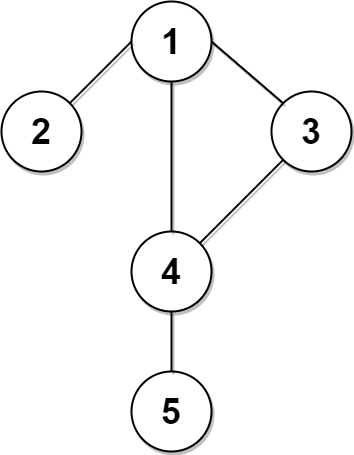 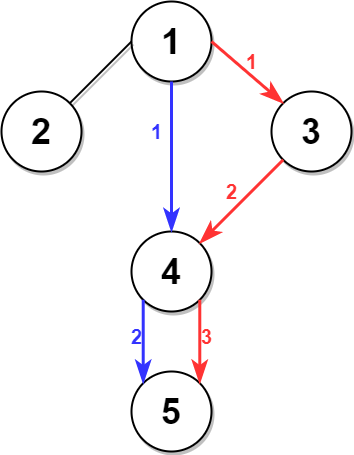
```
Input: n = 5, edges = [[1,2],[1,3],[1,4],[3,4],[4,5]], time = 3, change = 5
Output: 13
```

```
Input: n = 2, edges = [[1,2]], time = 3, change = 2
Output: 11
```
**Explanation:** The minimum time path is `1 -> 2` with time = 3 minutes. The second minimum time path is `1 -> 2 -> 1 -> 2` with time = 11 minutes.
### Constraints
* `2 <= n <= 104`
* `n - 1 <= edges.length <= min(2 * 104, n * (n - 1) / 2)`
* `edges[i].length == 2`
* `1 <= ui, vi <= n`
* `ui != vi`
* There are no duplicate edges.
* Each vertex can be reached directly or indirectly from every other vertex.
* `1 <= time, change <= 103`
## Solution
Reference implementation from [solution.py on GitHub](https://github.com/wislertt/leetcode-py/blob/main/leetcode/second_minimum_time_to_reach_destination/solution.py), full suite in [test\_solution.py](https://github.com/wislertt/leetcode-py/blob/main/leetcode/second_minimum_time_to_reach_destination/test_solution.py):
```python theme={"theme":{"light":"github-light","dark":"github-dark"}}
from collections import deque
class Solution:
# Time: O(n + m) BFS plus O(second_path_length) for the signal simulation
# Space: O(n + m)
def second_minimum(self, n: int, edges: list[list[int]], time: int, change: int) -> int:
adj: list[list[int]] = [[] for _ in range(n + 1)]
for u, v in edges:
adj[u].append(v)
adj[v].append(u)
# two smallest distinct arrival edge-counts per vertex (BFS order)
dists: list[list[int]] = [[] for _ in range(n + 1)]
dists[1].append(0)
queue: deque[tuple[int, int]] = deque([(1, 0)])
while queue:
node, steps = queue.popleft()
for nb in adj[node]:
nxt = steps + 1
if len(dists[nb]) < 2 and nxt not in dists[nb]:
dists[nb].append(nxt)
queue.append((nb, nxt))
elapsed = 0
for _ in range(dists[n][1]):
if (elapsed // change) % 2 == 1:
elapsed = (elapsed // change + 1) * change
elapsed += time
return elapsed
```
## Complexity
| Time | Space |
| - | - |
| O(n + m) BFS plus O(second\_path\_length) for the signal simulation | O(n + m) |
## Tags
[NeetCode All](/catalog/neetcode).
This documentation is built and hosted on [Mintlify](https://mintlify.com), a developer documentation platform.