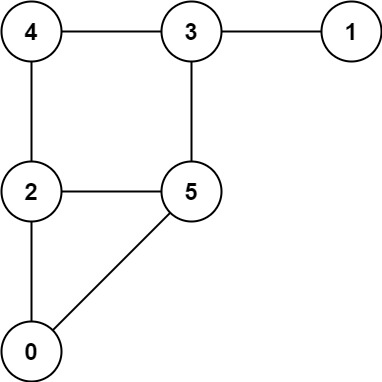
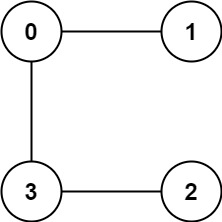
A game on an undirected graph is played by two players, Mouse and Cat, who alternate turns.The graph is given as follows: graph[a] is a list of all nodes b such that ab is an edge of the graph.The mouse starts at node 1 and goes first, the cat starts at node 2 and goes second, and there is a hole at node 0.During each player’s turn, they must travel along one edge of the graph that meets where they are. For example, if the Mouse is at node 1, it must travel to any node in graph[1].Additionally, it is not allowed for the Cat to travel to the Hole (node 0).Then, the game can end in three ways:
If ever the Cat occupies the same node as the Mouse, the Cat wins.
If ever the Mouse reaches the Hole, the Mouse wins.
If ever a position is repeated (i.e., the players are in the same position as a previous turn, and it is the same player’s turn to move), the game is a draw.
Given a graph, and assuming both players play optimally, return
from collections import dequeclass Solution: # Time: O(n^3) # Space: O(n^2) def cat_mouse_game(self, graph: list[list[int]]) -> int: n = len(graph) draw, mouse_win, cat_win = 0, 1, 2 # color[m][c][t]: result of the state with the mouse on m, the cat on c and # t picking the mover (0 mouse, 1 cat). Unresolved states stay draw. color = [[[draw] * 2 for _ in range(n)] for _ in range(n)] # degree[m][c][t]: how many of the mover's options are still undecided. degree = [[[0] * 2 for _ in range(n)] for _ in range(n)] for m in range(n): for c in range(n): degree[m][c][0] = len(graph[m]) degree[m][c][1] = len(graph[c]) - (0 in graph[c]) queue: deque[tuple[int, int, int]] = deque() for node in range(n): for turn in (0, 1): if node and color[node][node][turn] == draw: color[node][node][turn] = cat_win queue.append((node, node, turn)) if color[0][node][turn] == draw: color[0][node][turn] = mouse_win queue.append((0, node, turn)) while queue: m, c, turn = queue.popleft() outcome = color[m][c][turn] if turn == 0: # A resolved mouse-to-move state was reached by the cat moving. parents = [(m, prev_c, 1) for prev_c in graph[c] if prev_c != 0] else: # A resolved cat-to-move state was reached by the mouse moving. parents = [(prev_m, c, 0) for prev_m in graph[m]] for prev_m, prev_c, prev_turn in parents: if color[prev_m][prev_c][prev_turn] != draw: continue if outcome == prev_turn + mouse_win: # The mover can step into a state it already wins. color[prev_m][prev_c][prev_turn] = outcome queue.append((prev_m, prev_c, prev_turn)) else: degree[prev_m][prev_c][prev_turn] -= 1 if degree[prev_m][prev_c][prev_turn] == 0: # Every option loses, so the state is lost for the mover. color[prev_m][prev_c][prev_turn] = outcome queue.append((prev_m, prev_c, prev_turn)) return color[1][2][0]