There are n cities connected by some number of flights. You are given an array flights where flights[i] = [fromi, toi, pricei] indicates that there is a flight from city fromi to city toi with cost pricei.You are also given three integers src, dst, and k, return the cheapest price from src to dst with at most k stops. If there is no such route, return -1.
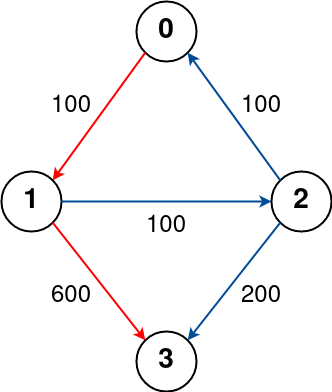
Input: n = 4, flights = [[0,1,100],[1,2,100],[2,0,100],[1,3,600],[2,3,200]], src = 0, dst = 3, k = 1Output: 700Explanation:The graph is shown above.The optimal path with at most 1 stop from city 0 to 3 is marked in red and has cost 100 + 600 = 700.Note that the path through cities [0,1,2,3] is cheaper but is invalid because it uses 2 stops.
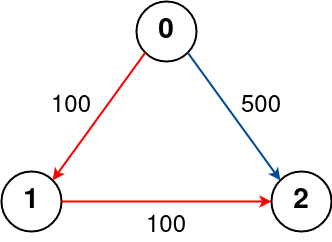
Input: n = 3, flights = [[0,1,100],[1,2,100],[0,2,500]], src = 0, dst = 2, k = 1Output: 200Explanation:The graph is shown above.The optimal path with at most 1 stop from city 0 to 2 is marked in red and has cost 100 + 100 = 200.
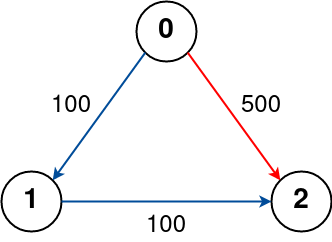
Input: n = 3, flights = [[0,1,100],[1,2,100],[0,2,500]], src = 0, dst = 2, k = 0Output: 500Explanation:The graph is shown above.The optimal path with no stops from city 0 to 2 is marked in red and has cost 500.
from collections import dequeclass Solution: # Time: O(K * E) where E is number of flights # Space: O(V) where V is number of cities def find_cheapest_price( self, n: int, flights: list[list[int]], src: int, dst: int, k: int ) -> int: # Build adjacency list adj = [[] for _ in range(n)] for from_i, to_i, price_i in flights: adj[from_i].append((to_i, price_i)) # BFS with stops constraint prices = [float("inf")] * n prices[src] = 0 queue = deque([(src, 0, 0)]) # (node, current_price, stops) while queue: node, current_price, stops = queue.popleft() if stops > k: continue for neighbor, price in adj[node]: new_price = current_price + price if new_price < prices[neighbor]: prices[neighbor] = new_price queue.append((neighbor, new_price, stops + 1)) return int(prices[dst]) if prices[dst] != float("inf") else -1