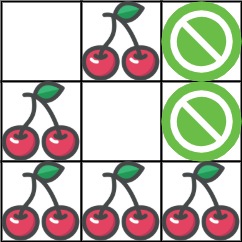
Input: grid = [[0,1,-1],[1,0,-1],[1,1,1]]Output: 5Explanation: The player started at (0, 0) and went down, down, right right to reach (2, 2).4 cherries were picked up during this single trip, and the matrix becomes [[0,1,-1],[0,0,-1],[0,0,0]].Then, the player went left, up, up, left to return home, picking up one more cherry.The total number of cherries picked up is 5, and this is the maximum possible.
class Solution:
    # Time: O(n^3) steps x O(n^2) row pairs
    # Space: O(n^2)
    def cherry_pickup(self, grid: list[list[int]]) -> int:
        n = len(grid)
        # -1 marks unreachable states (cherry counts are always >= 0)
        unreachable = -1
        # dp[r1][r2]: max cherries with both walkers on diagonal r + c = t
        dp = [[unreachable] * n for _ in range(n)]
        dp[0][0] = grid[0][0]

        for t in range(1, 2 * n - 1):
            ndp = [[unreachable] * n for _ in range(n)]
            for r1 in range(max(0, t - n + 1), min(n, t + 1)):
                for r2 in range(r1, min(n, t + 1)):
                    c1, c2 = t - r1, t - r2
                    if grid[r1][c1] == -1 or grid[r2][c2] == -1:
                        continue
                    best = unreachable
                    for pr1 in (r1 - 1, r1):
                        for pr2 in (r2 - 1, r2):
                            if 0 <= pr1 < n and 0 <= pr2 < n and dp[pr1][pr2] > best:
                                best = dp[pr1][pr2]
                    if best < 0:
                        continue
                    cherries = grid[r1][c1]
                    if r1 != r2:
                        cherries += grid[r2][c2]
                    ndp[r1][r2] = best + cherries
            dp = ndp

        return max(dp[n - 1][n - 1], 0)