You are playing a game involving a circular array of non-zero integers nums. Each nums[i] denotes the number of indices forward/backward you must move if you are located at index i:
If nums[i] is positive, move nums[i] steps forward, and
If nums[i] is negative, move abs(nums[i]) steps backward.
Since the array is circular, you may assume that moving forward from the last element puts you on the first element, and moving backwards from the first element puts you on the last element.A cycle in the array consists of a sequence of indices seq of length k where:
Following the movement rules above results in the repeating index sequence seq[0] -> seq[1] -> ... -> seq[k - 1] -> seq[0] -> ...
Every nums[seq[j]] is either all positive or all negative.
k > 1
Return true if there is a cycle in nums, or false otherwise.
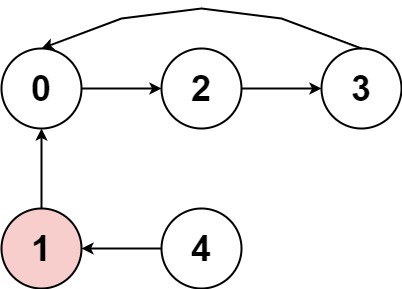
Explanation: The graph shows how the indices are connected. White nodes are jumping forward, while red is jumping backward.
We can see the cycle 0 -> 2 -> 3 -> 0 -> …, and all of its nodes are white (jumping in the same direction).
Input: nums = [-1,-2,-3,-4,-5,6]Output: false
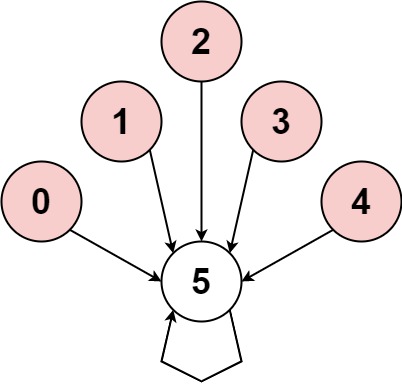
Explanation: The graph shows how the indices are connected. White nodes are jumping forward, while red is jumping backward.
The only cycle is of size 1, so we return false.
Input: nums = [1,-1,5,1,4]Output: true
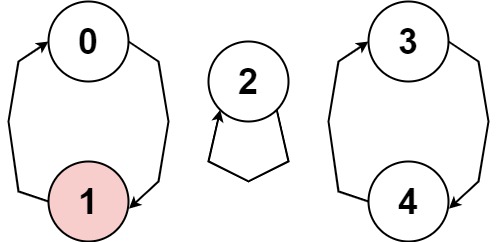
Explanation: The graph shows how the indices are connected. White nodes are jumping forward, while red is jumping backward.
We can see the cycle 0 -> 1 -> 0 -> …, and while it is of size > 1, it has a node jumping forward and a node jumping backward, so it is not a cycle.
We can see the cycle 3 -> 4 -> 3 -> …, and all of its nodes are white (jumping in the same direction).
class Solution:
    # Time: O(n)
    # Space: O(1)
    def circular_array_loop(self, nums: list[int]) -> bool:
        n = len(nums)

        def nxt(i: int) -> int:
            return (i + nums[i]) % n

        for start in range(n):
            if nums[start] == 0:
                continue
            forward = nums[start] > 0

            def ok(j: int, forward: bool = forward) -> bool:
                return nums[j] != 0 and (nums[j] > 0) == forward

            slow = start
            fast = nxt(slow)
            while ok(fast) and ok(nxt(fast)):
                if slow == fast:
                    if nxt(slow) != slow:
                        return True
                    break
                slow = nxt(slow)
                fast = nxt(nxt(fast))

            # The walk from `start` cannot yield a valid cycle; mark it dead.
            i = start
            for _ in range(n):
                if not ok(i):
                    break
                nums[i], i = 0, nxt(i)
        return False