Given the root node of a binary tree, your task is to create a string representation of the tree following a specific set of formatting rules. The representation should be based on a preorder traversal of the binary tree and must adhere to the following guidelines:
Node Representation: Each node in the tree should be represented by its integer value.
Parentheses for Children: If a node has at least one child (either left or right), its children should be represented inside parentheses. Specifically:
If a node has a left child, the value of the left child should be enclosed in parentheses immediately following the node’s value.
If a node has a right child, the value of the right child should also be enclosed in parentheses. The parentheses for the right child should follow those of the left child.
Omitting Empty Parentheses: Any empty parentheses pairs (i.e., ()) should be omitted from the final string representation of the tree, with one specific exception: when a node has a right child but no left child. In such cases, you must include an empty pair of parentheses to indicate the absence of the left child. This ensures that the one-to-one mapping between the string representation and the original binary tree structure is maintained.
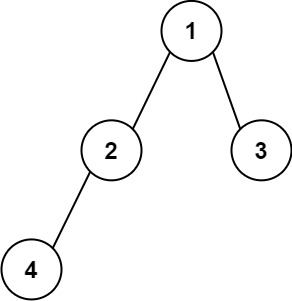
Input: root = [1,2,3,4]Output: "1(2(4))(3)"Explanation: Originally, it needs to be "1(2(4)())(3()())", but you need to omit all the empty parenthesis pairs. And it will be "1(2(4))(3)".
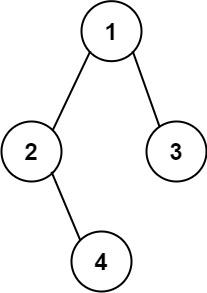
Input: root = [1,2,3,null,4]Output: "1(2()(4))(3)"Explanation: Almost the same as the first example, except the () after 2 is necessary to indicate the absence of a left child for 2 and the presence of the right child.
from leetcode_py import TreeNodeclass Solution: # Time: O(n) # Space: O(n) def tree2str(self, root: TreeNode[int] | None) -> str: if root is None: return "" left = self.tree2str(root.left) right = self.tree2str(root.right) if root.left is None and root.right is not None: return f"{root.val}()({right})" if root.right is not None: return f"{root.val}({left})({right})" if root.left is not None: return f"{root.val}({left})" return str(root.val)