You are given a 0-indexed 1-dimensional (1D) integer array original, and two integers, m and n. You are tasked with creating a 2-dimensional (2D) array with m rows and n columns using all the elements from original.The elements from indices 0 to n - 1 (inclusive) of original should form the first row of the constructed 2D array, the elements from indices n to 2 * n - 1 (inclusive) should form the second row of the constructed 2D array, and so on.Return anm x n2D array constructed according to the above procedure, or an empty 2D array if it is impossible.
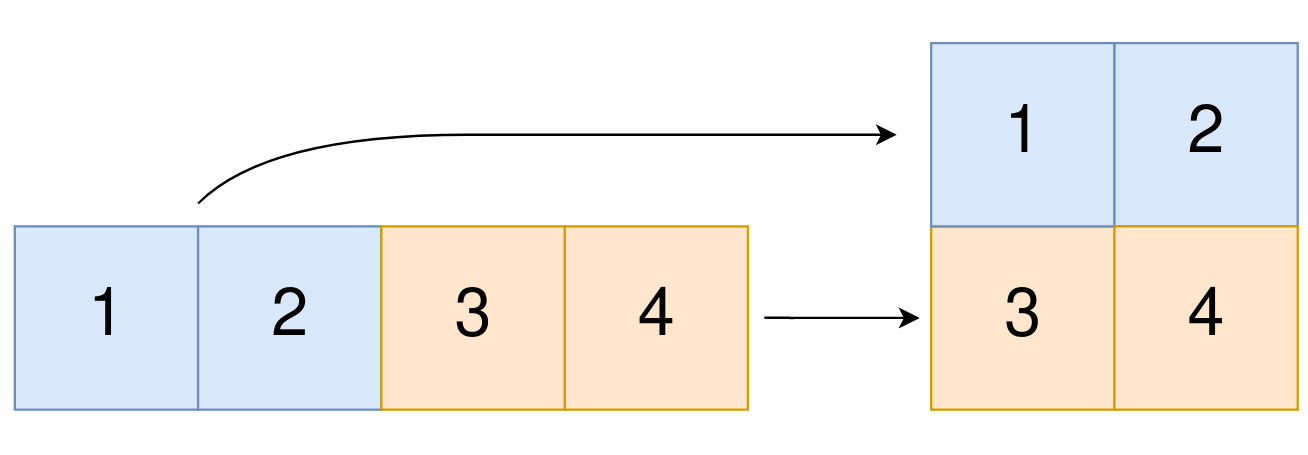
Input: original = [1,2,3,4], m = 2, n = 2Output: [[1,2],[3,4]]Explanation: The constructed 2D array should contain 2 rows and 2 columns.The first group of n=2 elements in original, [1,2], becomes the first row in the constructed 2D array.The second group of n=2 elements in original, [3,4], becomes the second row in the constructed 2D array.
Input: original = [1,2,3], m = 1, n = 3Output: [[1,2,3]]Explanation: The constructed 2D array should contain 1 row and 3 columns.Put all three elements in original into the first row of the constructed 2D array.
Input: original = [1,2], m = 1, n = 1Output: []Explanation: There are 2 elements in original.It is impossible to fit 2 elements in a 1x1 2D array, so return an empty 2D array.
class Solution:
    # Time: O(len(original))
    # Space: O(m * n) for the output
    def construct_2d_array(self, original: list[int], m: int, n: int) -> list[list[int]]:
        if len(original) != m * n:
            return []
        return [original[i * n : (i + 1) * n] for i in range(m)]