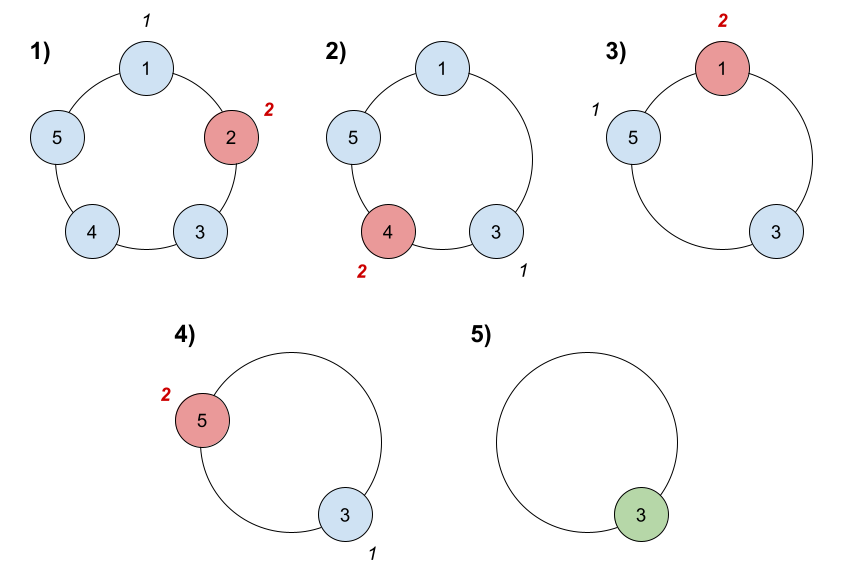
<p>There are <code>n</code> friends that are playing a game. The friends are sitting in a circle and are numbered from <code>1</code> to <code>n</code> in <strong>clockwise order</strong>. More formally, moving clockwise from the <code>i<sup>th</sup></code> friend brings you to the <code>(i+1)<sup>th</sup></code> friend for <code>1 <= i < n</code>, and moving clockwise from the <code>n<sup>th</sup></code> friend brings you to the <code>1<sup>st</sup></code> friend.</p><p>The rules of the game are as follows:</p><ol>
<li><strong>Start</strong> at the <code>1<sup>st</sup></code> friend.</li>
<li>Count the next <code>k</code> friends in the clockwise direction <strong>including</strong> the friend you started at. The counting wraps around the circle and may count some friends more than once.</li>
<li>The last friend you counted leaves the circle and loses the game.</li>
<li>If there is still more than one friend in the circle, go back to step <code>2</code> <strong>starting</strong> from the friend <strong>immediately clockwise</strong> of the friend who just lost and repeat.</li>
<li>Else, the last friend in the circle wins the game.</li>
</ol><p>Given the number of friends, <code>n</code>, and an integer <code>k</code>, return <em>the winner of the game</em>.</p>
Input: n = 5, k = 2Output: 3Explanation: Here are the steps of the game:1) Start at friend 1.2) Count 2 friends clockwise, which are friends 1 and 2.3) Friend 2 leaves the circle. Next start is friend 3.4) Count 2 friends clockwise, which are friends 3 and 4.5) Friend 4 leaves the circle. Next start is friend 5.6) Count 2 friends clockwise, which are friends 5 and 1.7) Friend 1 leaves the circle. Next start is friend 3.8) Count 2 friends clockwise, which are friends 3 and 5.9) Friend 5 leaves the circle. Only friend 3 is left, so they are the winner.
Input: n = 6, k = 5Output: 1Explanation: The friends leave in this order: 5, 4, 6, 2, 3. The winner is friend 1.