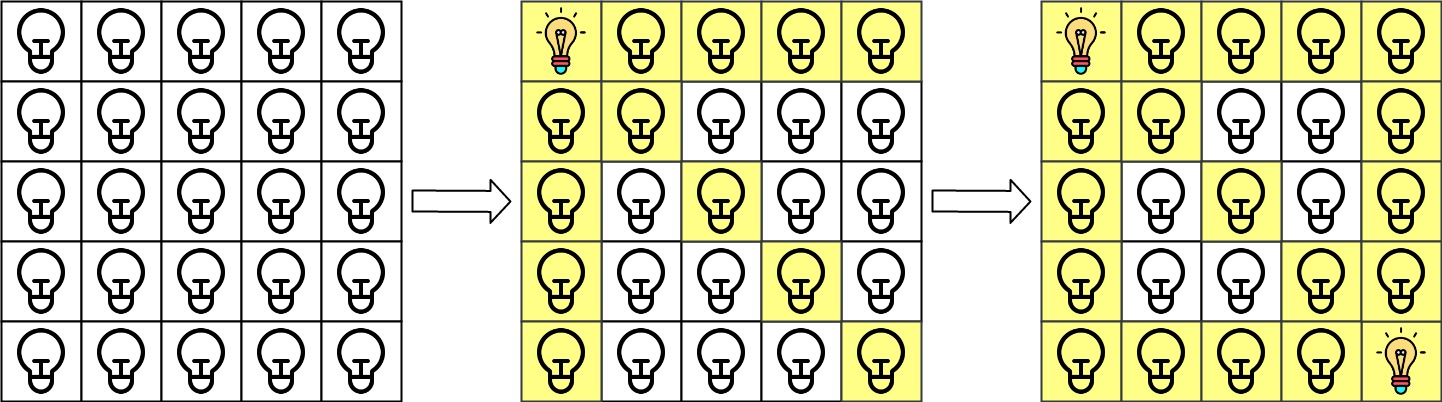
There is a 2D grid of size n x n where each cell of this grid has a lamp that is initially turned off.You are given a 2D array of lamp positions lamps, where lamps[i] = [row_i, col_i] indicates that the lamp at grid[row_i][col_i] is turned on. Even if the same lamp is listed more than once, it is turned on.When a lamp is turned on, it illuminates its cell and all other cells in the same row, column, or diagonal.You are also given another 2D array queries, where queries[j] = [row_j, col_j]. For the j<sup>th</sup> query, determine whether grid[row_j][col_j] is illuminated or not. After answering the j<sup>th</sup> query, turn off the lamp at grid[row_j][col_j] and its 8 adjacent lamps if they exist. A lamp is adjacent if its cell shares either a side or corner with grid[row_j][col_j].Return an array of integersans,* where ans[j] should be 1 if the cell in the j<sup>th</sup> query was illuminated, or 0 if the lamp was not.
Input: n = 5, lamps = [[0,0],[4,4]], queries = [[1,1],[1,0]]Output: [1,0]Explanation: We have the initial grid with all lamps turned off. In the above picture we see the grid after turning on the lamp at grid[0][0] then turning on the lamp at grid[4][4].The 0th query asks if the lamp at grid[1][1] is illuminated or not (the blue square). It is illuminated, so set ans[0] = 1. Then, we turn off all lamps in the red square.