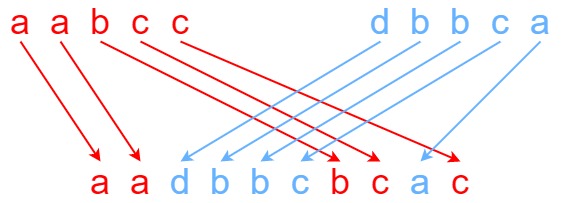
Given strings s1, s2, and s3, find whether s3 is formed by an interleaving of s1 and s2.An interleaving of two strings s and t is a configuration where s and t are divided into n and m substrings respectively, such that:
s = s1 + s2 + … + sn
t = t1 + t2 + … + tm
|n - m| <= 1
The interleaving is s1 + t1 + s2 + t2 + s3 + t3 + … or t1 + s1 + t2 + s2 + t3 + s3 + …
Note:a + b is the concatenation of strings a and b.
Input: s1 = "aabcc", s2 = "dbbca", s3 = "aadbbcbcac"Output: trueExplanation: One way to obtain s3 is:Split s1 into s1 = "aa" + "bc" + "c", and s2 into s2 = "dbbc" + "a".Interleaving the two splits, we get "aadbbcbcac".
Input: s1 = "aabcc", s2 = "dbbca", s3 = "aadbbbaccc"Output: falseExplanation: Notice how it is hard to find a viable interleaving because s3 must preserve the character order of s1 and s2.
class Solution:
    # Time: O(m * n)
    # Space: O(n) using a single rolling row
    def is_interleave(self, s1: str, s2: str, s3: str) -> bool:
        m, n = len(s1), len(s2)
        if m + n != len(s3):
            return False
        if n > m:
            # Ensure s1 is the longer string so the rolling row stays minimal
            return self.is_interleave(s2, s1, s3)

        # dp[j] = True if s3[:i+j] is an interleaving of s1[:i] and s2[:j]
        dp = [False] * (n + 1)
        for i in range(m + 1):
            for j in range(n + 1):
                if i == 0 and j == 0:
                    dp[j] = True
                elif i == 0:
                    dp[j] = dp[j - 1] and s2[j - 1] == s3[j - 1]
                elif j == 0:
                    dp[j] = dp[j] and s1[i - 1] == s3[i - 1]
                else:
                    dp[j] = (dp[j] and s1[i - 1] == s3[i + j - 1]) or (
                        dp[j - 1] and s2[j - 1] == s3[i + j - 1]
                    )
        return dp[n]