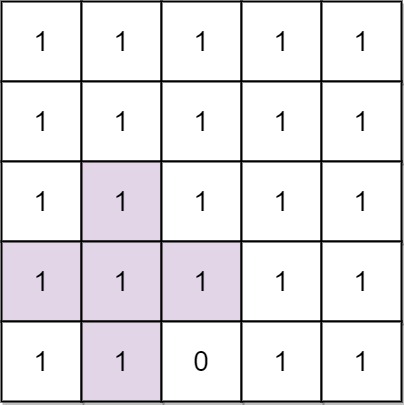
You are given an integer n. You have an n x n binary grid grid with all values initially 1’s except for some indices given in the array mines. The i^th element of the array mines is defined as mines[i] = [x_i, y_i] where grid[x_i][y_i] == 0.Return the order of the largest axis-aligned plus sign of 1*‘s contained in* grid. If there is none, return 0.An axis-aligned plus sign of 1’s of order k has some center grid[r][c] == 1 along with four arms of length k - 1 going up, down, left, and right, and made of 1’s. Note that there could be 0’s or 1’s beyond the arms of the plus sign, only the relevant area of the plus sign is checked for 1’s.
class Solution:
    # Time: O(n^2)
    # Space: O(n^2)
    def order_of_largest_plus_sign(self, n: int, mines: list[list[int]]) -> int:
        blocked = {(x, y) for x, y in mines}

        # dp[r][c] = length of the run of 1s ending at (r, c) in the current direction
        dp = [[n] * n for _ in range(n)]

        for r in range(n):
            # left to right
            run = 0
            for c in range(n):
                run = 0 if (r, c) in blocked else run + 1
                dp[r][c] = min(dp[r][c], run)
            # right to left
            run = 0
            for c in range(n - 1, -1, -1):
                run = 0 if (r, c) in blocked else run + 1
                dp[r][c] = min(dp[r][c], run)

        for c in range(n):
            # top to bottom
            run = 0
            for r in range(n):
                run = 0 if (r, c) in blocked else run + 1
                dp[r][c] = min(dp[r][c], run)
            # bottom to top
            run = 0
            for r in range(n - 1, -1, -1):
                run = 0 if (r, c) in blocked else run + 1
                dp[r][c] = min(dp[r][c], run)

        return max(max(row) for row in dp)