Given a directed acyclic graph, with n vertices numbered from 0 to n - 1, and an array edges where edges[i] = [from_i, to_i] represents a directed edge from node from_i to node to_i.Find the smallest set of vertices from which all nodes in the graph are reachable. It’s guaranteed that a unique solution exists.Notice that you can return the vertices in any order.
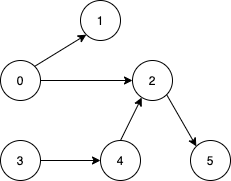
Input: n = 6, edges = [[0,1],[0,2],[2,5],[3,4],[4,2]]Output: [0,3]
Explanation: It’s not possible to reach all the nodes from a single vertex. From 0 we can reach [0,1,2,5]. From 3 we can reach [3,4,2,5]. So we output [0,3].
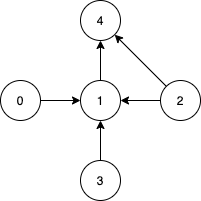
Input: n = 5, edges = [[0,1],[2,1],[3,1],[1,4],[2,4]]Output: [0,2,3]
Explanation: Notice that vertices 0, 3 and 2 are not reachable from any other node, so we must include them. Also any of these vertices can reach nodes 1 and 4.
class Solution:
    # Time: O(n + e)
    # Space: O(n)
    def find_smallest_set_of_vertices(self, n: int, edges: list[list[int]]) -> list[int]:
        has_incoming = [False] * n
        for _from, to in edges:
            has_incoming[to] = True
        return [node for node in range(n) if not has_incoming[node]]