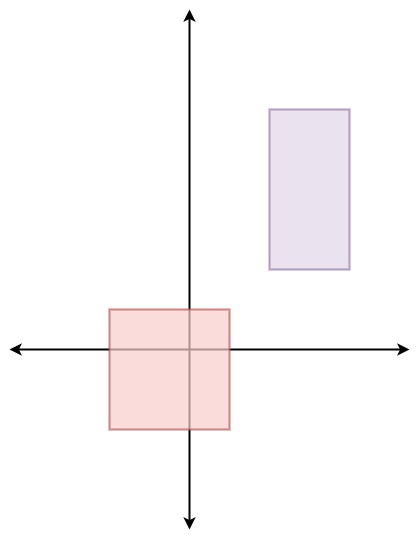
You are given an array of non-overlapping axis-aligned rectangles rects where rects[i] = [ai, bi, xi, yi] indicates that (ai, bi) is the bottom-left corner point of the ith rectangle and (xi, yi) is the top-right corner point of the ith rectangle. Design an algorithm to pick a random integer point inside the space covered by one of the given rectangles. A point on the perimeter of a rectangle is included in the space covered by the rectangle.Any integer point inside the space covered by one of the given rectangles should be equally likely to be returned.Note that an integer point is a point that has integer coordinates.Implement the Solution class:
Solution(int[][] rects) Initializes the object with the given rectangles rects.
int[] pick() Returns a random integer point [u, v] inside the space covered by one of the given rectangles.
import randomfrom bisect import bisect_rightclass Solution: # Weight the rectangles by their integer-point counts with a prefix sum, # draw a uniform offset into the total, bisect to the owning rectangle and # map the leftover offset onto a (col, row) inside it. Every integer point # (perimeter included) gets exactly one offset, so points are uniform. # Time: __init__ O(n), pick O(log n) # Space: O(n) def __init__(self, rects: list[list[int]]) -> None: self._rects = rects self._prefix: list[int] = [] total = 0 for a, b, x, y in rects: total += (x - a + 1) * (y - b + 1) self._prefix.append(total) self._total = total def pick(self) -> list[int]: target = random.randrange(self._total) idx = bisect_right(self._prefix, target) base = self._prefix[idx - 1] if idx else 0 a, b, x, _ = self._rects[idx] width = x - a + 1 offset = target - base return [a + offset % width, b + offset // width]