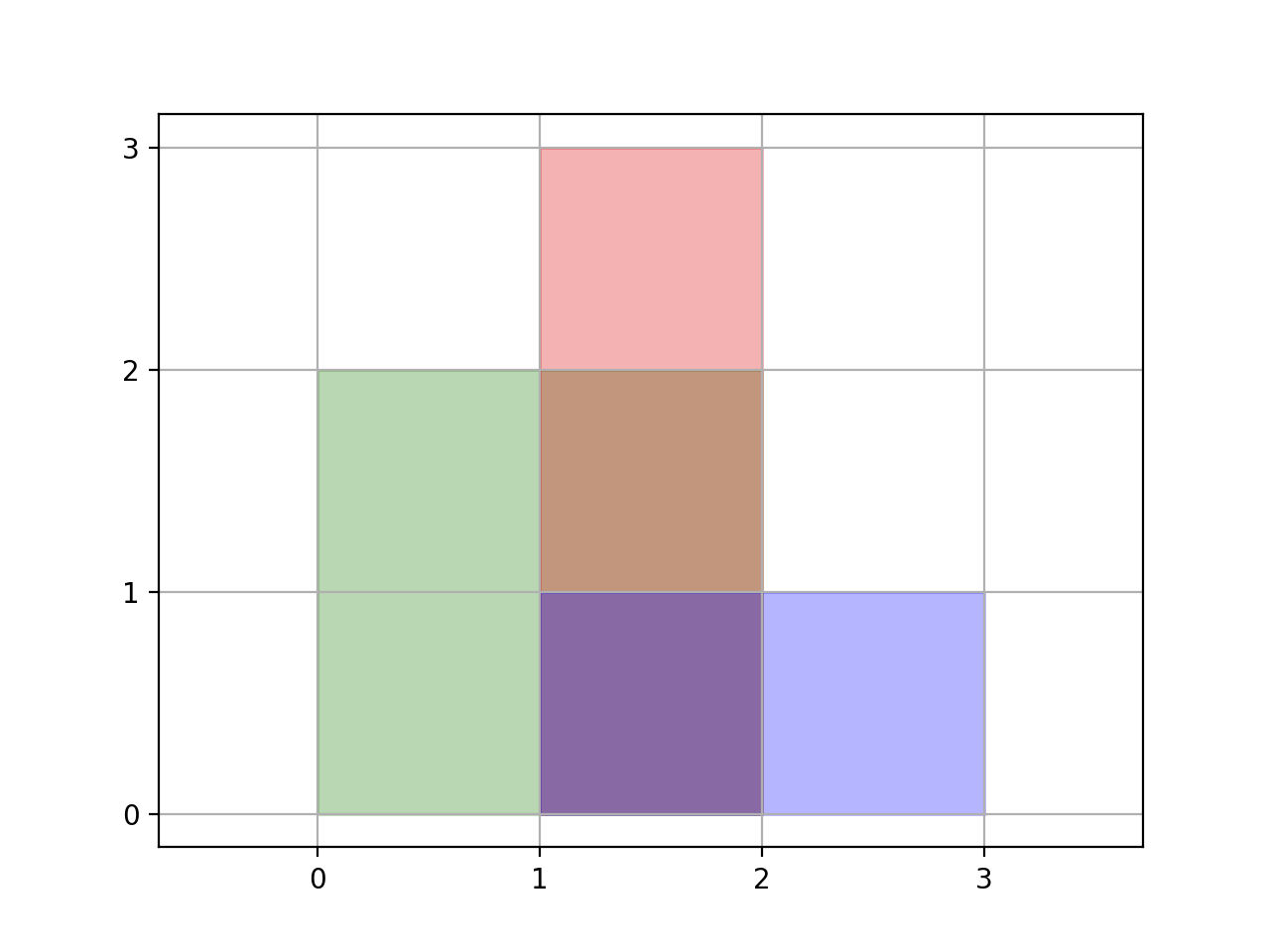
You are given a 2D array of axis-aligned rectangles. Each rectangle[i] = [xi1, yi1, xi2, yi2] denotes the ith rectangle where (xi1, yi1) are the coordinates of the bottom-left corner, and (xi2, yi2) are the coordinates of the top-right corner.Calculate the total area covered by all rectangles in the plane. Any area covered by two or more rectangles should only be counted once.Return the total area. Since the answer may be too large, return it modulo 10^9 + 7.
Input: rectangles = [[0,0,2,2],[1,0,2,3],[1,0,3,1]]Output: 6Explanation: A total area of 6 is covered by all three rectangles, as illustrated in the picture.From (1,1) to (2,2), the green and red rectangles overlap.From (1,0) to (2,3), all three rectangles overlap.
Input: rectangles = [[0,0,1000000000,1000000000]]Output: 49Explanation: The answer is 10^18 modulo (10^9 + 7), which is 49.
class Solution:
    # Time: O(n^2) cells per sweep with n <= 200 rectangles, so ~10^5 cell updates
    # Space: O(n^2) for the compressed coverage grid
    def rectangle_area(self, rectangles: list[list[int]]) -> int:
        mod = 1_000_000_007
        xs = sorted({r[0] for r in rectangles} | {r[2] for r in rectangles})
        ys = sorted({r[1] for r in rectangles} | {r[3] for r in rectangles})
        x_index = {x: i for i, x in enumerate(xs)}
        y_index = {y: i for i, y in enumerate(ys)}
        covered = [[False] * (len(ys) - 1) for _ in range(len(xs) - 1)]
        for x1, y1, x2, y2 in rectangles:
            for i in range(x_index[x1], x_index[x2]):
                row = covered[i]
                for j in range(y_index[y1], y_index[y2]):
                    row[j] = True
        total = 0
        for i in range(len(xs) - 1):
            width = xs[i + 1] - xs[i]
            row = covered[i]
            for j in range(len(ys) - 1):
                if row[j]:
                    total += width * (ys[j + 1] - ys[j])
        return total % mod